OpenAI’s Sora app, which lets users generate and share AI videos into a social feed, launched as an invite-only app on September 30. It hit the top of the US App Store within 3 days. It nabbed its first 1M downloads in under 5 days.
It kept ascending: in early November it started relaxing its invite-only restriction, and it launched on Android, topping the Play Store charts with 470K installs on its first day! That month Sora reached 1M daily active users, per Similarweb.
OpenAI’s choice to launch with minimal guardrails was risky, especially with respect to potential IP infringement. But it was, predictably, paying off as it made the app all-the-more viral. If that sounds like Facebook’s “move fast and break things” approach, there may be something to that: OpenAI had been on a hiring spree of Meta growth personnel. Hundreds of headlines over the first couple of months made it reasonable to assume users were loving their feeds of AI-generated content.
In October, the app’s popularity compelled many to reassess their mental model of how online content worked. Did this app mark a paradigm shift away from human-made social media content? Some high-profile creators wondered if humans would get edged out. Casey Neistat posted a terrifically fun video on October 4: “SORA: the all Ai TikTok Clone. will slop end creativity?” The gravity of the moment for him was palpable, with his friends concluding “it’s over”.
Neistat’s fears echoed other creators’ concerns. Throughout this period, Hollywood stars were mobilizing and speaking out against how the app was allowing their likenesses to be ripped off.
On October 6, Ben Thompson took the opposite take, saying it “may be the single most exciting manifestation of AI yet, and the most encouraging in terms of AI’s impact on humans. Everyone — including lots of people in my Sora feed — are leaning into the concept of AI slop, which I get: we are looking at a world of infinite machine-generated content, and a lot of it is going to be terrible. At the same time, how incredible is it to give everyone with an iPhone a creative outlet?” Using the word “creative” felt like a stretch, but regardless, Sora’s viral success seemed like the most interesting development in the space since YouTube.
Meanwhile, throughout this period, OpenAI was of course in talks to raise its next round at lofty valuations (as high as $830B). It stands to reason that these talks likely featured Sora’s massive popularity as an attractive selling point. To date, no public announcements have been made about any of these deals closing.
The app’s initial success also played a key role in landing a $1B investment from Disney.
The buzz then started to fade a bit; in December, DAUs had fallen to 750K, per Similarweb. Also in early December, Sensor Tower said users were averaging just 13 minutes per day on Sora vs. 90 on TikTok.
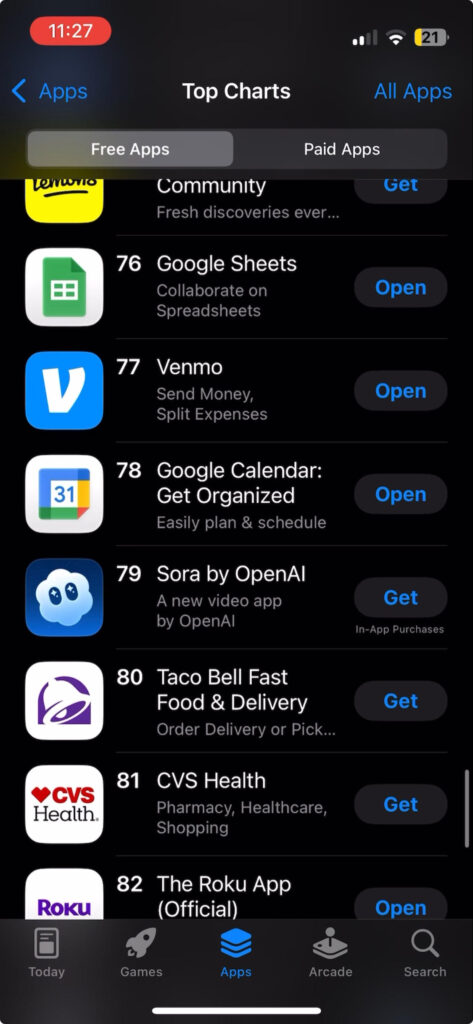
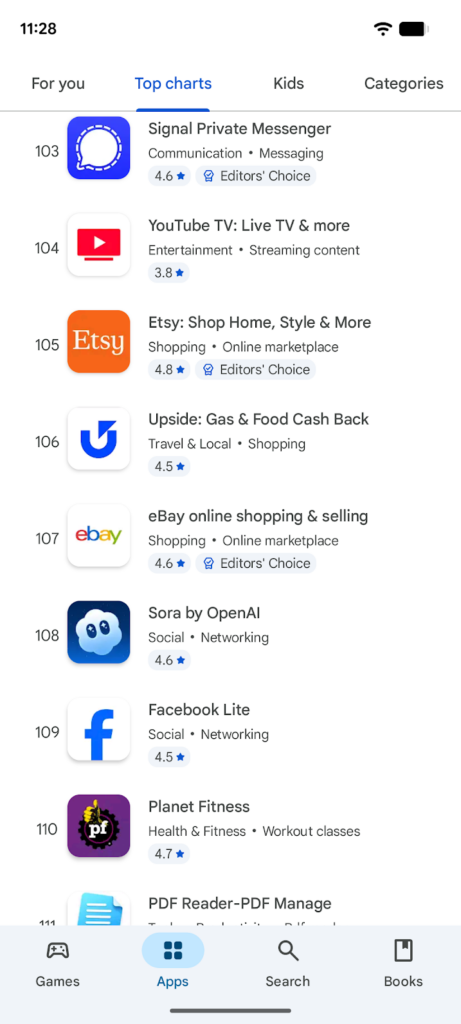
And now, the app is fluctuating between #70 and #80 (last night it was #79) in the US iOS Free Top Charts. And it is the 8th most popular free app in the Photo & Video category, behind Meta Vibes. It currently stands at the 108th spot on the Play Store. Ben Thompson has come around on it too, acknowledging its dip and saying “Yes, I get the argument that this is the worst that AI will ever be, but it also will never be human, which is what humans want most of all.”
While AI slop remains extremely “popular” on services that feature human-created content (though often as malicious content including sexually explicit deepfakes of normal people and celebrities alike, which publications like 404media have meticulously documented): perhaps the Sora’s experiment is teaching us whether people enjoy feeds that exclusively feature slop.